Popular on s4story
- Sun Gate Golf Retirement Community Doesn't have a Shuffleboard. It Solves Murder Mysteries - 122
- Akiti the Hunter Launches Mission to Deliver One Million Books to One Million Children Worldwide - 114
- Dividend Stacker Launches Free Calendar and Alerts for High-Yield ETF Payouts - 103
- Johnnie Mandela Releases THOUGHT in the Age of AI
- New Book Asks Caregivers to Look Past Dementia—and See the Person
- Wilber Chitambo's From Pain to Purpose: A Healing Journey Offers a Powerful Testament to Healing
- DAZN Review 2026: Streaming Price Worth It?
- New Book Revisits Berny Dohrmann, CEO Space and the People Who Powered The Space
- Supreme Garage Door Repair Redirects Marketing Dollars Into North Texas Communities
- Sales Blueprint Architect Launches, Helping Sales Professionals, Business Owners, and Consultants Close More Business With AI
Lunai Bioworks (N A S D A Q: LNAI) Takes Parkinson's Discovery to the Next Level With Exclusive Tanaist Agreement
S For Story/10703487
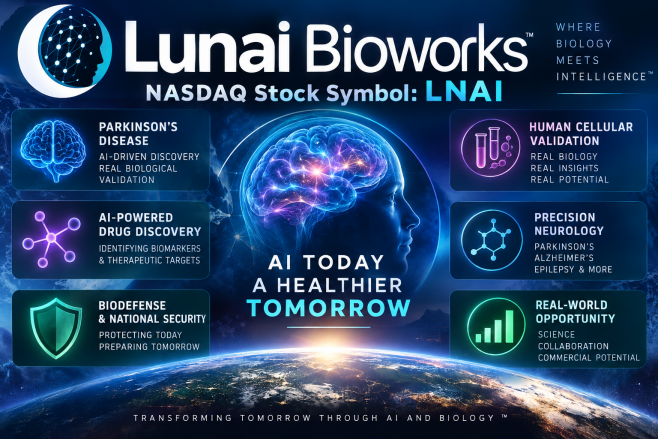

New worldwide agreement adds human cellular validation to Lunai's AI-driven Parkinson's platform, creating a potential path from patient subtypes and biomarkers to biological mechanisms and therapeutic targets. Positioned for $400M to $1.2 Billion US Countermeasures Program with AI Platform to Meet Battlefield and Terrorism Threats. $LNAI Names Six Broker-Dealers in Expanded Naked Short Selling Suit
SACRAMENTO, Calif. - s4story -- Lunai Bioworks, Inc. (N A S D A Q: LNAI) $LNAI is continuing to build an increasingly sophisticated platform at the intersection of artificial intelligence, precision medicine, neuroscience and biodefense — and its latest Parkinson's development could become one of the company's most important pieces of the story.
Lunai has announced an exclusive worldwide license and collaboration agreement with Tanaist, Inc., adding human cellular phenotyping capabilities to its growing Parkinson's disease discovery and validation platform.
The agreement is significant because it addresses a critical question facing AI-driven drug discovery: Can computationally identified patient subtypes and disease signals be reproduced in actual human biology?
Through its wholly owned BioSymetrics subsidiary and its Augusta AI platform, Lunai has already identified three clinically distinct Parkinson's patient subtypes from longitudinal clinical and proteomic data. The new Tanaist collaboration is designed to take that work another step — connecting those patient-defined subtypes to measurable differences in human cellular biology.
That could create a more complete development pathway:
Patient Stratification → Biological Validation → Biomarkers → Therapeutic Targets
Tanaist Adds a New Biological Lens
Under the agreement, Lunai receives exclusive rights to Tanaist's licensed cellular phenotyping technology within the Parkinson's disease field for programs based on Lunai's patient phenoclusters.
The companies plan to evaluate whether Lunai's clinical and proteomic signatures can be reproduced across additional Parkinson's cohorts and whether those signatures correspond to distinct cellular phenotypes.
That is an important distinction.
Rather than stopping with an AI-generated classification, Lunai is seeking to determine whether those classifications have underlying biological meaning.
Tanaist's precision-medicine platform combines patient data with dynamic human cellular phenotyping. According to the companies, the scientific approach supporting the platform has been described in peer-reviewed research published in Nature Genetics and Science Translational Medicine, including research connecting human cellular phenotypes with genetic mechanisms, disease biology and potential therapeutic targets.
For Lunai, that creates another independent validation layer around its Parkinson's program.
Three Parkinson's Subtypes Become the Foundation
Lunai previously analyzed longitudinal clinical information and more than 4,500 proteomic probes from more than 650 participants in the Parkinson's Progression Markers Initiative (PPMI).
More on S For Story
The Augusta AI analysis identified three clinically distinct Parkinson's subtypes associated with different disease-progression patterns.
The groups were characterized by:
The analysis connected baseline clinical and proteomic characteristics with subsequent disease progression over a median follow-up of approximately 2.5 years, with many participants followed for more than five years.
The next question is arguably even more important: Do these differences correspond to different underlying biology?
The Tanaist agreement is designed to help answer that question.
If the patient subtypes can be reproduced across independent cohorts and connected to measurable cellular mechanisms, the findings could potentially become more useful for patient enrichment, biomarker development and therapeutic-target selection.
LNAI Is Building Multiple Validation Paths
The Tanaist agreement also complements Lunai's previously announced collaboration with BrainStorm Therapeutics.
In August, Lunai announced a definitive Master Collaboration Agreement with BrainStorm focused on Parkinson's disease, with an initial data readout targeted for the first half of 2027.
That collaboration combines Lunai's AI-based patient stratification and biomarker capabilities with BrainStorm's patient-derived human midbrain organoid technology.
Together, the BrainStorm and Tanaist relationships give Lunai multiple experimental approaches for testing its computational findings.
The strategic objective is becoming clearer: Lunai is not simply attempting to use AI to identify patterns in Parkinson's disease. It is building a framework designed to determine which AI-derived signals are reproducible, biologically meaningful and potentially actionable for therapeutic development.
From AI Discovery Toward Therapeutic Application
This is where the newest agreement could become particularly interesting to investors.
AI can identify patterns across enormous datasets that may be difficult to recognize using traditional approaches. But pharmaceutical development ultimately requires biological validation.
Lunai's stated strategy is therefore moving toward a more integrated model in which:
AI identifies patient subtypes → human biology tests those hypotheses → biomarkers help identify relevant patients → therapeutic targets can be prioritized.
Dr. Gabe Musso, Chief Scientific Officer at BioSymetrics, described the Tanaist collaboration as an important step in moving Lunai's Parkinson's findings from computational discovery toward therapeutic application.
The company says Lunai will own collaboration-generated analyses, biomarker findings and other results as provided under the agreement, while Tanaist retains ownership of its underlying platform.
Parkinson's Is Only One Part of the LNAI Story
While the Parkinson's platform is rapidly becoming a major component of the investment narrative, Lunai's broader strategy remains diversified.
More on S For Story
On September 16, 2026, BioSymetrics reported results from a technical case study evaluating AI-based screening for potential acetylcholinesterase (AChE) inhibition. Using NIH Tox21 data covering 9,667 compounds, Lunai reported an AUROC of 0.88, along with 33% precision at 70% recall and approximately 5.1-fold enrichment versus the dataset's reported 6.4% prevalence of AChE-active entries.
The company positioned the structure-based system as a potential downstream screening layer for molecules generated by AI systems, while emphasizing that the work is a technical case study and not evidence of clinical neurotoxicity prevention or a comprehensive chemical-threat detection system.
Lunai has also been pursuing biodefense applications and a revenue-generating defense collaboration, giving the company potential applications beyond conventional pharmaceutical discovery.
Key Catalysts Investors Will Be Watching
The rapidly expanding platform gives LNAI several areas to watch as the company moves forward:
Lunai has also been dealing with corporate and capital-markets issues, including litigation involving alleged naked short selling. In August, the company announced that its Second Amended Complaint named six registered broker-dealers and two broker-dealer principals as defendants. Those allegations remain subject to the judicial process. A September 4 company correction stated that it changed only the reference link to the complaint and did not alter the substantive content of the earlier release.
An Increasingly Interesting AI-Biotech Convergence Story
The latest Tanaist agreement potentially adds an important missing piece to the Lunai Bioworks story.
The company already has the AI, the patient data, the proteomic analysis and the identified Parkinson's subtypes. Now it is adding another avenue for determining whether those computational discoveries correspond to real, measurable human cellular biology.
That evolution could be important.
The potential value of AI-driven drug discovery ultimately depends not simply on finding patterns, but on determining which patterns can withstand independent validation and translate into meaningful biological and therapeutic hypotheses.
Lunai is attempting to build exactly that bridge.
With Tanaist providing human cellular phenotyping, BrainStorm providing complementary experimental validation, BioSymetrics providing AI-powered patient stratification, and the company continuing its chemical-risk and biodefense work, LNAI is developing a platform that spans several rapidly advancing areas of biotechnology.
The combination of AI-driven precision medicine, human biological validation, Parkinson's disease research, biodefense and chemical-risk screening gives Lunai Bioworks $LNAI multifaceted story for investors to follow.
For more information on LNAI visit: www.lunaibioworks.com
--------------------------------------------------------------------------------------------------------------
Media Contact
Company Name: Lunai Bioworks (N A S D A Q: LNAI)
Contact: Aysha Rashid
Email: aysha@lunaibioworks.com or Info@lunaibioworks.com
Phone: (424) 222-9301
Country: United States
DISCLAIMER: https://corporateads.com/disclaimer/
Disclosure listed on the CorporateAds website
Lunai has announced an exclusive worldwide license and collaboration agreement with Tanaist, Inc., adding human cellular phenotyping capabilities to its growing Parkinson's disease discovery and validation platform.
The agreement is significant because it addresses a critical question facing AI-driven drug discovery: Can computationally identified patient subtypes and disease signals be reproduced in actual human biology?
Through its wholly owned BioSymetrics subsidiary and its Augusta AI platform, Lunai has already identified three clinically distinct Parkinson's patient subtypes from longitudinal clinical and proteomic data. The new Tanaist collaboration is designed to take that work another step — connecting those patient-defined subtypes to measurable differences in human cellular biology.
That could create a more complete development pathway:
Patient Stratification → Biological Validation → Biomarkers → Therapeutic Targets
Tanaist Adds a New Biological Lens
Under the agreement, Lunai receives exclusive rights to Tanaist's licensed cellular phenotyping technology within the Parkinson's disease field for programs based on Lunai's patient phenoclusters.
The companies plan to evaluate whether Lunai's clinical and proteomic signatures can be reproduced across additional Parkinson's cohorts and whether those signatures correspond to distinct cellular phenotypes.
That is an important distinction.
Rather than stopping with an AI-generated classification, Lunai is seeking to determine whether those classifications have underlying biological meaning.
Tanaist's precision-medicine platform combines patient data with dynamic human cellular phenotyping. According to the companies, the scientific approach supporting the platform has been described in peer-reviewed research published in Nature Genetics and Science Translational Medicine, including research connecting human cellular phenotypes with genetic mechanisms, disease biology and potential therapeutic targets.
For Lunai, that creates another independent validation layer around its Parkinson's program.
Three Parkinson's Subtypes Become the Foundation
Lunai previously analyzed longitudinal clinical information and more than 4,500 proteomic probes from more than 650 participants in the Parkinson's Progression Markers Initiative (PPMI).
More on S For Story
- JEGS Launches Transformed Digital Commerce Platform Powered by PhaseZero
- Subject matter experts: Present your ideas at IISE Annual Conference 2027 in Louisville
- Debut Speculative Novel Reimagines a 1,200-Year-Old Irish Legend as Sci-Fi Thriller
- Cummings Graduate Institute Celebrates New Doctor of Behavioral Health Graduates
- Visit London Appoints The SEO Works for AI-First Search Strategy
The Augusta AI analysis identified three clinically distinct Parkinson's subtypes associated with different disease-progression patterns.
The groups were characterized by:
- Fast motor progression
- Rapid neurological and cognitive decline
- Female-enriched functional impairment
The analysis connected baseline clinical and proteomic characteristics with subsequent disease progression over a median follow-up of approximately 2.5 years, with many participants followed for more than five years.
The next question is arguably even more important: Do these differences correspond to different underlying biology?
The Tanaist agreement is designed to help answer that question.
If the patient subtypes can be reproduced across independent cohorts and connected to measurable cellular mechanisms, the findings could potentially become more useful for patient enrichment, biomarker development and therapeutic-target selection.
LNAI Is Building Multiple Validation Paths
The Tanaist agreement also complements Lunai's previously announced collaboration with BrainStorm Therapeutics.
In August, Lunai announced a definitive Master Collaboration Agreement with BrainStorm focused on Parkinson's disease, with an initial data readout targeted for the first half of 2027.
That collaboration combines Lunai's AI-based patient stratification and biomarker capabilities with BrainStorm's patient-derived human midbrain organoid technology.
Together, the BrainStorm and Tanaist relationships give Lunai multiple experimental approaches for testing its computational findings.
The strategic objective is becoming clearer: Lunai is not simply attempting to use AI to identify patterns in Parkinson's disease. It is building a framework designed to determine which AI-derived signals are reproducible, biologically meaningful and potentially actionable for therapeutic development.
From AI Discovery Toward Therapeutic Application
This is where the newest agreement could become particularly interesting to investors.
AI can identify patterns across enormous datasets that may be difficult to recognize using traditional approaches. But pharmaceutical development ultimately requires biological validation.
Lunai's stated strategy is therefore moving toward a more integrated model in which:
AI identifies patient subtypes → human biology tests those hypotheses → biomarkers help identify relevant patients → therapeutic targets can be prioritized.
Dr. Gabe Musso, Chief Scientific Officer at BioSymetrics, described the Tanaist collaboration as an important step in moving Lunai's Parkinson's findings from computational discovery toward therapeutic application.
The company says Lunai will own collaboration-generated analyses, biomarker findings and other results as provided under the agreement, while Tanaist retains ownership of its underlying platform.
Parkinson's Is Only One Part of the LNAI Story
While the Parkinson's platform is rapidly becoming a major component of the investment narrative, Lunai's broader strategy remains diversified.
More on S For Story
- Amid a National Addiction Crisis Psychologist Offers a New Path Forward
- Inglewood Associates and Gordon Brothers Provide Update on Sale Process for 925 Euclid Avenue in Cleveland
- Century Fasteners Corp. Exhibiting at the 2026 International Fastener Expo
- Hope Haven Publishing LLC Releases The Dementia Caregiver Daily Logbook
- Memoir on Estrangement and Midlife Expands into Bookstore and Library Distribution
On September 16, 2026, BioSymetrics reported results from a technical case study evaluating AI-based screening for potential acetylcholinesterase (AChE) inhibition. Using NIH Tox21 data covering 9,667 compounds, Lunai reported an AUROC of 0.88, along with 33% precision at 70% recall and approximately 5.1-fold enrichment versus the dataset's reported 6.4% prevalence of AChE-active entries.
The company positioned the structure-based system as a potential downstream screening layer for molecules generated by AI systems, while emphasizing that the work is a technical case study and not evidence of clinical neurotoxicity prevention or a comprehensive chemical-threat detection system.
Lunai has also been pursuing biodefense applications and a revenue-generating defense collaboration, giving the company potential applications beyond conventional pharmaceutical discovery.
Key Catalysts Investors Will Be Watching
The rapidly expanding platform gives LNAI several areas to watch as the company moves forward:
- Tanaist Parkinson's validation work and additional cohort analysis
- BrainStorm collaboration and targeted first-half 2027 data
- Validation of Lunai's three Parkinson's patient subtypes
- Potential biomarker and therapeutic-target discoveries
- Continued development of AI-powered chemical-risk screening
- Additional biodefense and government opportunities
Lunai has also been dealing with corporate and capital-markets issues, including litigation involving alleged naked short selling. In August, the company announced that its Second Amended Complaint named six registered broker-dealers and two broker-dealer principals as defendants. Those allegations remain subject to the judicial process. A September 4 company correction stated that it changed only the reference link to the complaint and did not alter the substantive content of the earlier release.
An Increasingly Interesting AI-Biotech Convergence Story
The latest Tanaist agreement potentially adds an important missing piece to the Lunai Bioworks story.
The company already has the AI, the patient data, the proteomic analysis and the identified Parkinson's subtypes. Now it is adding another avenue for determining whether those computational discoveries correspond to real, measurable human cellular biology.
That evolution could be important.
The potential value of AI-driven drug discovery ultimately depends not simply on finding patterns, but on determining which patterns can withstand independent validation and translate into meaningful biological and therapeutic hypotheses.
Lunai is attempting to build exactly that bridge.
With Tanaist providing human cellular phenotyping, BrainStorm providing complementary experimental validation, BioSymetrics providing AI-powered patient stratification, and the company continuing its chemical-risk and biodefense work, LNAI is developing a platform that spans several rapidly advancing areas of biotechnology.
The combination of AI-driven precision medicine, human biological validation, Parkinson's disease research, biodefense and chemical-risk screening gives Lunai Bioworks $LNAI multifaceted story for investors to follow.
For more information on LNAI visit: www.lunaibioworks.com
--------------------------------------------------------------------------------------------------------------
Media Contact
Company Name: Lunai Bioworks (N A S D A Q: LNAI)
Contact: Aysha Rashid
Email: aysha@lunaibioworks.com or Info@lunaibioworks.com
Phone: (424) 222-9301
Country: United States
DISCLAIMER: https://corporateads.com/disclaimer/
Disclosure listed on the CorporateAds website
Source: CorporateAds
0 Comments
Latest on S For Story
- New Children's Book "Frolly Found a Dolly in the Park" Celebrates Empathy and the Joy of Help
- "Ghost Girl" Theresa St. John Guides Readers Through New York's Most Haunted Locations
- Ragin' Cajun Announces New Cheeseburger Seasoning on National Cheeseburger Day
- Warrant Activity, AVERSA™ Progress and a Potentially Transformative Fall Take Center Stage: Nutriband Inc. (N A S D A Q: NTRB)
- Put Your Herd on Your Phone: Kiko Nation Makes Livestock Management Simple
- Future Intelligence Think Tank Surpasses 1,000 Members Exploring Human and Artificial Intelligence
- Humphrey Jr. Returns Brings a Beloved Northern California Whale Story to a New Generation
- Gary Bernstein Expands Media Leadership Role With Senior Strategic Advisor Appointment To Blacksun Private Equity
- A. Q. Adams Completes New Short Story
- Headline: House of Nova Paints Every Face in Gold at New York Fashion Week
- Can Government Operate Better Through Innovation?
- Michael H. Kaplan Advocates for Seriously Injured Colorado Workers Who Need In-Home Care
- Governor Laura Kelly Proclaims September 26 University Press of Kansas Day
- Childhood nickname inspires whimsical Australian children's book The Wonky Woo
- La Quema del Año Viejo en Venezuela explora una tradición de memoria
- Infinity Infusion Solutions Named Finalist for D Magazine's D CEO 2026 Excellence in Healthcare Awards
- New 666-Page Book Examines America, Israel, Iran, the Middle East, History—and Biblical Prophecy
- Pittsburgh Creators Launch Clever New Children's Book, "The Sock Sleuth!"
- "The Man From Rock Bottom" Wins 2026 FAPA President's Book Award
- Canadian Tint Expo 2027: Why Every Window Tinter Should Compete in Niagara Falls on April 3rd & 4th