Popular on s4story
- From the Racetrack to the Boardroom: Aston Martin and Aramco Formula One Partnership Accelerates Circle8 Group: (N A S D A Q: CIRC) - 131
- Leeds Billboard Campaign Drives 188% Traffic Uplift as AI Enquiries Rise 266% for Loud! OOH - 109
- Bandrúi: The Female Druids of the Celtic World - 102
- The Legacy Table: A Celebration of Faith, Family & Legacy
- Impact & Influence May 2025: Joel Rodriguez Tirado on Helping Families & Seizing the Moment
- Book On Shelves Launches to Help Independent and Self-Published Authors Get Their Books
- James D. White Sr. Inspires Healing in New Book, What's Going On Behind the Mask?
- Minus K Technology launches it Educational Giveaway for Universities and Colleges in the USA
- Dynamic Dachshund Dog Goes Global: Remember Point Launches a New Bilingual Children's Book
- Phinge Exposes Massive AI Security Risks, Claiming Its Patented Hardware-Verified Architecture Is The Only Safeguard Against Surveillance Capitalism
Similar on s4story
- Phinge Exposes Massive AI Security Risks, Claiming Its Patented Hardware-Verified Architecture Is The Only Safeguard Against Surveillance Capitalism
- DuraFast Label Company Launches Seiko SLP850 2" Thermal Printer with Free Label Promotion
- 5.6 Million EUR in Q1 Project Awards for Integrated IoT Solutions / Data Analytics Subsidiary of Smart City Developer: Affluence (Stock Symbol: AFFU)
- Merger Advancement For Embodied AI Co in Robotic Systems Serving High Value Hospitality, Gaming & Real Estate Sectors: MBody AI Corp. (NAS DAQ: MBAI)
- Tickeron Highlights AI Trading Agent Performance Across Multiple Market Sectors
- OPUS Global Data Solutions Launches Food Trader Plus, Bringing Operational Control and Deal-Level Profit Visibility to Food Brokers
- ImagineX Named to 2026 Inc. 5000 List of America's Fastest-Growing Private Companies
- Lineus Medical Elevates Leadership to Accelerate Growth After Breakthrough Clinical Results
- XRPPower Expands Platform Security With Enhanced Brand Protection and Official Verification Standards
- RAS AP Consulting Expands Managed AP Governance™ Ecosystem, Launches Trademark Process, and Secures IFOL Speaker Invitation
New analysis reveals second job workers keep just 80p in every pound they earn
S For Story/10694340

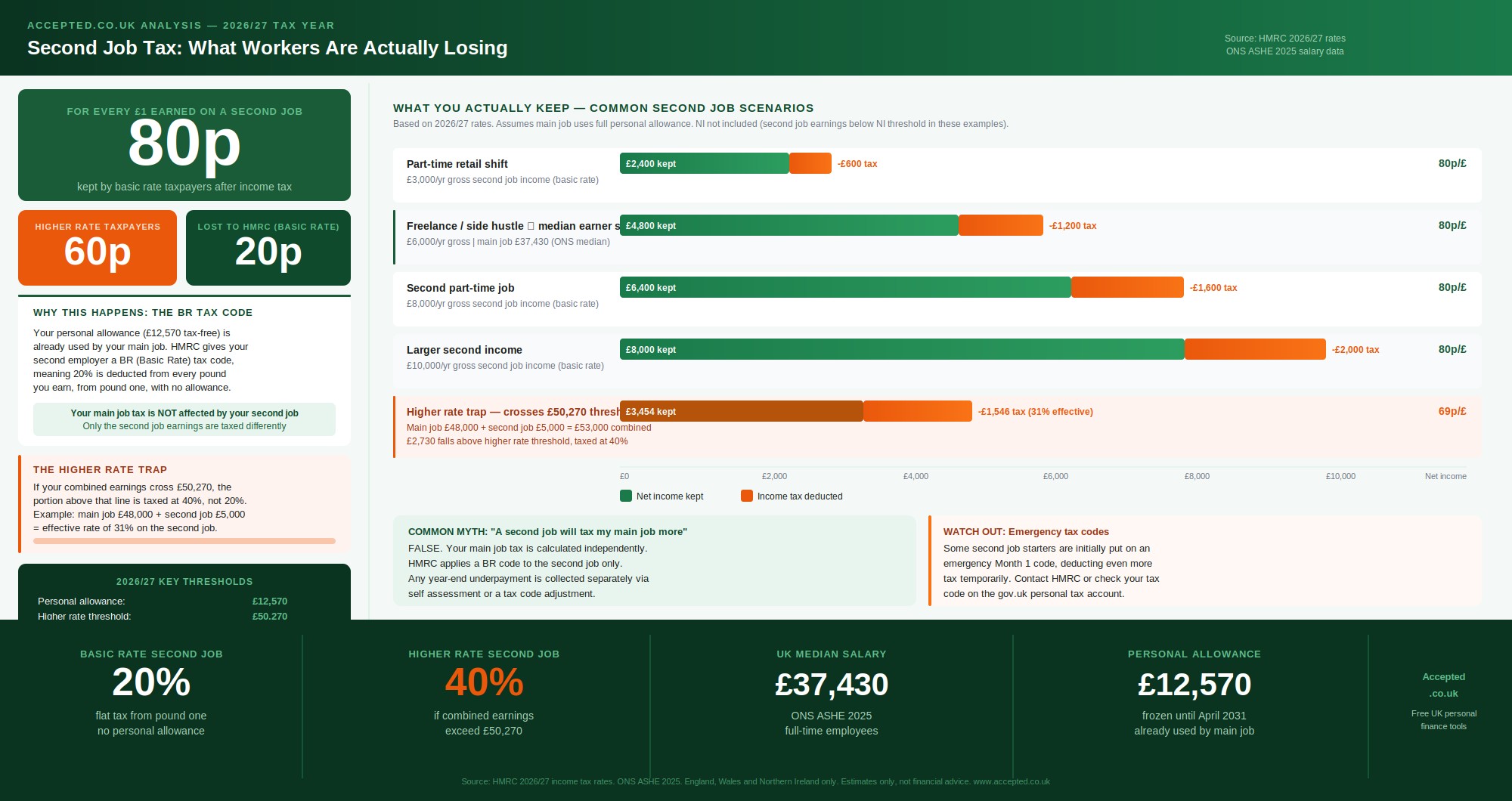

Research by free financial tools site Accepted.co.uk has calculated what workers with a second job actually take home after tax, revealing that the typical second-job earner loses 20p in every pound to HMRC before they see a penny, with those pushed into the higher rate band losing up to 40p in every pound.
BRAMHALL, STOCKPORT, U.K. - s4story -- Analysis by Accepted.co.uk, using 2026/27 income tax and National Insurance rates, has modelled the real take-home pay from a second job across a range of common earnings scenarios, from part-time retail shifts to freelance side hustles.
The research finds that a worker on the UK's median full-time salary of £37,430 who takes on a second job earning £6,000 a year, the equivalent of roughly two shifts a week in retail or hospitality, will lose £1,200 of that to income tax before they receive a penny. That leaves them with £4,800, or 80p for every pound earned. The position worsens for anyone whose combined earnings from both jobs push them above the £50,270 higher rate threshold. At that point, every additional pound earned on the second job is taxed at 40 per cent rather than 20 per cent, leaving higher rate workers with just 60p in the pound.
The confusion stems from how HMRC codes second jobs. Because the personal allowance, the £12,570 of earnings on which no income tax is paid, is already allocated to the main job, a second employer is instructed to apply a BR tax code. BR stands for basic rate and means a flat 20 per cent is deducted from every pound of second job income from the very first pound, with no tax-free allowance applied. Workers who are initially put on an emergency tax code can find themselves temporarily losing even more until the code is corrected.
More on S For Story
David Morris, Personal Finance Editor at Accepted.co.uk, commented: "A lot of people take on a second job expecting to keep most of what they earn, then get a nasty surprise when they see their first payslip. Twenty per cent off the top from pound one is a real shock when you are used to a personal allowance absorbing the first £12,570. The BR code is correct, but it catches people off guard every time."
The analysis also highlights a threshold trap affecting workers on higher salaries. Someone earning £48,000 in their main job who takes on a second role paying £5,000 will see their combined income reach £53,000, pulling £2,730 above the higher rate threshold of £50,270. The portion of second job income that crosses that line is taxed at 40 per cent rather than 20 per cent, meaning the effective tax rate across the full second job is around 31 per cent rather than the flat 20 per cent many would assume.
The research comes as more British workers than at any point in the past decade are taking on additional employment to manage rising living costs. HMRC data shows second job registrations have increased significantly since 2022, with an estimated 1.2 million workers now holding more than one employment simultaneously.
One common misconception the analysis addresses is the fear that taking a second job will increase the tax paid on the main job. This does not happen. Income tax is assessed across all income at the end of the tax year, but the main job itself is not retrospectively taxed more heavily because of second job earnings. Only the second job income is affected by the loss of the personal allowance.
More on S For Story
Data source and methodology: All tax calculations are based on confirmed 2026/27 income tax rates and thresholds for England, Wales and Northern Ireland. Personal allowance £12,570, basic rate 20 per cent on earnings from £12,571 to £50,270, higher rate 40 per cent above £50,270. Employee National Insurance: 8 per cent on earnings between £12,570 and £50,270, 2 per cent above. National Insurance is assessed per employment and does not accumulate across jobs in the same way as income tax. UK median full-time salary figure (£37,430) is sourced from the ONS Annual Survey of Hours and Earnings (ASHE) 2025, published November 2025. Scotland operates separate income tax bands and rates; figures in this release apply to England, Wales and Northern Ireland only.
Scope: Calculations assume no pension contributions, student loan deductions, benefits in kind, or other adjustments to taxable income. Results are estimates and individual circumstances will vary.
About: Accepted.co.uk is a free UK personal finance information and tools site offering 24 calculators and 40+ editorial guides across tax, mortgages, credit, savings, and business finance. The site carries no paywalls, advertising, or sponsored content. Readers can calculate their own second job take-home pay using the free Two Jobs Tax Calculator at
Media contact: David Morris, dave@accepted.co.uk
Disclaimer: The figures in this release are estimates based on publicly available tax rates and average earnings data. They do not constitute financial or tax advice. Individual circumstances vary and readers should consult a qualified adviser or use HMRC's own tools before making decisions.
The research finds that a worker on the UK's median full-time salary of £37,430 who takes on a second job earning £6,000 a year, the equivalent of roughly two shifts a week in retail or hospitality, will lose £1,200 of that to income tax before they receive a penny. That leaves them with £4,800, or 80p for every pound earned. The position worsens for anyone whose combined earnings from both jobs push them above the £50,270 higher rate threshold. At that point, every additional pound earned on the second job is taxed at 40 per cent rather than 20 per cent, leaving higher rate workers with just 60p in the pound.
The confusion stems from how HMRC codes second jobs. Because the personal allowance, the £12,570 of earnings on which no income tax is paid, is already allocated to the main job, a second employer is instructed to apply a BR tax code. BR stands for basic rate and means a flat 20 per cent is deducted from every pound of second job income from the very first pound, with no tax-free allowance applied. Workers who are initially put on an emergency tax code can find themselves temporarily losing even more until the code is corrected.
More on S For Story
- Solid Earth Introduces RealtyID, a Universal Identity Spine for the Real Estate Industry
- New Memoir Takes Readers Along on a Post-Retirement Travel Journey
- History Matters: The Death of Rudolph Valentino, August 1926
- BlazeHive's AI SEO Agent Outranks Human Writers on 500+ Google Top-3 Results in 5 Months, on Autopilot
- Phinge Exposes Massive AI Security Risks, Claiming Its Patented Hardware-Verified Architecture Is The Only Safeguard Against Surveillance Capitalism
David Morris, Personal Finance Editor at Accepted.co.uk, commented: "A lot of people take on a second job expecting to keep most of what they earn, then get a nasty surprise when they see their first payslip. Twenty per cent off the top from pound one is a real shock when you are used to a personal allowance absorbing the first £12,570. The BR code is correct, but it catches people off guard every time."
The analysis also highlights a threshold trap affecting workers on higher salaries. Someone earning £48,000 in their main job who takes on a second role paying £5,000 will see their combined income reach £53,000, pulling £2,730 above the higher rate threshold of £50,270. The portion of second job income that crosses that line is taxed at 40 per cent rather than 20 per cent, meaning the effective tax rate across the full second job is around 31 per cent rather than the flat 20 per cent many would assume.
The research comes as more British workers than at any point in the past decade are taking on additional employment to manage rising living costs. HMRC data shows second job registrations have increased significantly since 2022, with an estimated 1.2 million workers now holding more than one employment simultaneously.
One common misconception the analysis addresses is the fear that taking a second job will increase the tax paid on the main job. This does not happen. Income tax is assessed across all income at the end of the tax year, but the main job itself is not retrospectively taxed more heavily because of second job earnings. Only the second job income is affected by the loss of the personal allowance.
More on S For Story
- Phinge & CEO Robert DeMaio Publicly Declare Cash Settlements or Judgments Alone Cannot & Will Not Remedy the Deep Public Harm of Infringing Its IP
- Dana Flanagan Expands the Authority Architect, Bringing a Nontraditional Approach to Executive Authority, Strategic Access and Business Growth
- Phinge's Netverse: Reclaiming the Digital Frontier For Everyone Through CEO Robert DeMaio's Vision of a True App-less, User Data Sovereign World
- DuraFast Label Company Launches Seiko SLP850 2" Thermal Printer with Free Label Promotion
- Vibrations of Resistance Launches September 3 on Viking 2 Mars Landing Anniversary
Data source and methodology: All tax calculations are based on confirmed 2026/27 income tax rates and thresholds for England, Wales and Northern Ireland. Personal allowance £12,570, basic rate 20 per cent on earnings from £12,571 to £50,270, higher rate 40 per cent above £50,270. Employee National Insurance: 8 per cent on earnings between £12,570 and £50,270, 2 per cent above. National Insurance is assessed per employment and does not accumulate across jobs in the same way as income tax. UK median full-time salary figure (£37,430) is sourced from the ONS Annual Survey of Hours and Earnings (ASHE) 2025, published November 2025. Scotland operates separate income tax bands and rates; figures in this release apply to England, Wales and Northern Ireland only.
Scope: Calculations assume no pension contributions, student loan deductions, benefits in kind, or other adjustments to taxable income. Results are estimates and individual circumstances will vary.
About: Accepted.co.uk is a free UK personal finance information and tools site offering 24 calculators and 40+ editorial guides across tax, mortgages, credit, savings, and business finance. The site carries no paywalls, advertising, or sponsored content. Readers can calculate their own second job take-home pay using the free Two Jobs Tax Calculator at
Media contact: David Morris, dave@accepted.co.uk
Disclaimer: The figures in this release are estimates based on publicly available tax rates and average earnings data. They do not constitute financial or tax advice. Individual circumstances vary and readers should consult a qualified adviser or use HMRC's own tools before making decisions.
Source: Accepted.co.uk
0 Comments
Latest on S For Story
- New Book Announcement - Jefferson's Landmark Deal by Lara M. Brown
- New Book Announcement - Democracy on the Edge by John Kenneth White and Matthew R. Kerbel
- synseer Nominated for Best Startup in 2026 Prix Galien USA Awards Following Record Breaking Applicant Pool
- Leading PDR Training Courses in Canada: Learn Paintless Dent Repair with PDR Academy & Tint Academy
- Move in this Fall! New Released Quick Move-In Townhomes at Heritage at South Brunswick with Limited-Time Incentives
- Crossroads4Hope Marks 25 Years Ensuring No One Faces Cancer Alone At its Inspiring Hope Gala
- "Our Lady of the Artilects" Comes to Audio with Kobna Holdbrook-Smith
- Q1 2026 Arizona Technology Industry Impact Report Recaps Advanced Manufacturing Growth, High-Value Jobs and Workforce Investment
- Vietnam Veteran Bruce Goldwell Releases "United We Stand," a Call to Reject Political Division
- Military Writers Society of America Announces 2026 Awards Season Finalists
- Former Prosecutor Opens Stegall Law in Summerville
- Vboost Celebrates 14 years of Automotive Viral Marketing
- Picaboo Helps Family Recover 16 Years of Memories After Devastating House Fire
- Ignazio Arces Wins Stevie® Award for Maverick of the Year at the 2026 International Business Awards
- New from Regal House, The Great Awakening: dark comic vision of a split nation veering off the rails
- Tickeron Highlights AI Trading Agent Performance Across Multiple Market Sectors
- Stop Bleeding Cash on Mediocre Talent. Build a Powerhouse Remote Team Instead
- Crownlight Strategies® Announces Federal Trademark Registration
- Lead Empowered Launches Write Empowered to Turn Ideas Into Impactful Content
- New Book Calls 'Sense of Belonging' the Missing Link in Student Success